Designing for the Inevitable Pivot: Backward Compatibility as a First-Class Architectural Decision
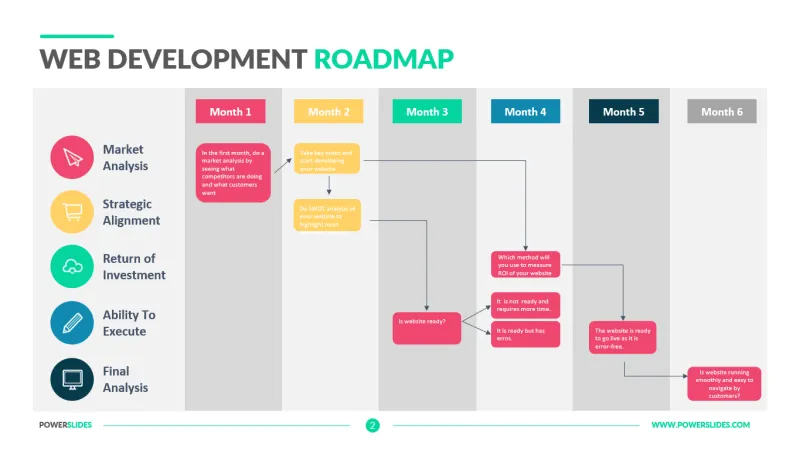
Photo: web developer planning roadmap strategy whiteboard timeline, via powerslides.com
At some point, every web system encounters a change it was not designed to accommodate gracefully. An API contract that made perfect sense eighteen months ago now conflicts with a new product requirement. A data schema that reflected the business logic of last year no longer maps cleanly to the business logic of today. A third-party integration that the architecture was built around has announced a deprecation timeline.
These moments are not failures of foresight. They are the expected behavior of any system operating in a real business environment. The question is not whether change will arrive—it will—but whether the architecture was planned with sufficient runway to absorb it without triggering a cascading renegotiation of every system that depends on it.
Backward compatibility, understood this way, is not a maintenance concern to be addressed after the fact. It is a strategic property to be designed in from the beginning.
Why Compatibility Is Treated as an Afterthought
The pattern is familiar to most web professionals. A system is designed to solve the problem at hand. Versioning, deprecation paths, and compatibility constraints are deferred because they add complexity before that complexity is demonstrably necessary. The system ships, consumers build against it, and the architecture calcifies faster than anyone anticipated.
When change eventually arrives—and it always does—the team faces a choice between a breaking change that forces coordinated updates across every consumer, or an accumulating set of workarounds that preserve the old interface while bolting new behavior alongside it. Neither outcome is clean. Both are significantly more expensive than they would have been if compatibility had been treated as a design requirement rather than a retrofit.
The root cause is rarely negligence. It is a rational response to incentives. Compatibility infrastructure costs time now, and its benefits are realized later, often by different teams or under different leadership. In organizations without explicit architectural governance, this trade-off reliably resolves in favor of shipping.
Versioning as a Planning Instrument
Versioning strategy is the most visible expression of a team's theory about how their system will change. It is also one of the most consequential decisions an architect can make early in a system's life, because it establishes the grammar through which future evolution will be communicated.
For APIs specifically, the choice between URI versioning (/v1/, /v2/), header-based versioning, and content negotiation is less important than the discipline with which any chosen approach is applied. What matters most is that the versioning strategy encodes a clear contract: what constitutes a breaking change, how long deprecated versions will be supported, and what migration path consumers can expect.
Semantic versioning, widely adopted in the US software ecosystem for library and package management, offers a useful conceptual model even for teams building web services rather than distributable packages. The core principle—that breaking changes, new capabilities, and patches each carry distinct signals—translates directly to API design. A team that communicates version increments with that level of semantic precision gives consumers the information they need to make informed integration decisions.
What versioning cannot do is substitute for architectural decisions about where version boundaries should be drawn. A versioning scheme applied at the wrong granularity creates either too many versions to maintain or too few to provide meaningful compatibility guarantees. The right unit of versioning is typically the contract surface that a specific consumer class depends on—not the entire system, and not individual endpoints in isolation.
Deprecation as a Discipline, Not an Event
Most teams treat deprecation as something that happens when a new version is ready. In practice, effective deprecation is a continuous process that begins the moment a new interface is introduced.
This means making deprecation timelines explicit and public from the outset. Consumers of an API or internal service should know, at the time of adoption, what the expected lifecycle of that interface is—not as a legal disclaimer, but as a genuine planning input. A US-based platform serving enterprise customers, for instance, may need to commit to deprecation windows measured in years rather than quarters. A developer-facing API with a more agile consumer base might operate on a shorter cycle. The point is that the timeline should be stated, not implied.
It also means investing in the tooling that makes deprecation visible. Deprecation headers in HTTP responses, warning logs triggered by calls to sunset endpoints, and automated monitoring that tracks which consumers are still using deprecated interfaces are not luxuries—they are the operational infrastructure that makes planned deprecation possible rather than aspirational.
Finally, it means treating the deprecation period as a migration partnership rather than a countdown. The teams responsible for maintaining the system should have active visibility into which consumers have migrated and which have not, and should be prepared to provide migration support rather than simply waiting for the deadline to pass.
Architectural Patterns That Support Graceful Evolution
Beyond versioning and deprecation practice, certain architectural patterns offer structural support for systems that need to evolve without breaking their consumers.
The Strangler Fig Pattern is particularly well-suited to teams that need to replace a component without a hard cutover. By routing traffic through an intermediary that progressively shifts requests from the old implementation to the new one, teams can validate the replacement incrementally while maintaining full backward compatibility throughout the transition. This is not a new pattern, but it remains one of the most reliable approaches available for high-stakes infrastructure replacement.
Expand-Contract Migrations offer a disciplined approach to schema and interface changes. The expansion phase introduces the new capability alongside the old one, allowing consumers to begin adopting the new interface at their own pace. The contraction phase, which removes the old interface, is deferred until adoption is sufficiently complete. This two-phase approach transforms what would otherwise be a breaking change into a planned, observable transition.
Tolerance for Unknown Fields in API design—the practice of designing consumers to ignore fields they do not recognize rather than failing on them—is a low-cost investment with significant long-term returns. Systems built with this tolerance can absorb additive changes to their dependencies without requiring updates, substantially reducing the coordination overhead of routine evolution.
When to Make Breaking Changes Deliberately
None of this argues for infinite backward compatibility. There are circumstances in which a breaking change is the correct architectural decision—when the cost of maintaining a compatibility layer exceeds the cost of coordinating a migration, when the old interface encodes assumptions that are now actively harmful, or when the consumer base is small enough and coordinated enough that a hard cutover is genuinely less expensive than a transition period.
The discipline required is not to avoid breaking changes but to make them deliberately. A breaking change made with explicit notice, a clear migration path, adequate lead time, and organizational support for affected consumers is a fundamentally different event than a breaking change made because the team ran out of patience with the old interface. The former is a strategic decision. The latter is a planning failure.
Building Runway Into Today's Decisions
The most durable architectural choices are those made with an honest assessment of their own shelf life. No interface lasts forever. No data model perfectly anticipates the requirements that will emerge two years from now. What separates systems that age gracefully from those that become liabilities is not the quality of the original predictions—it is the deliberateness with which the architecture was designed to accommodate being wrong.
For web architects making decisions today, the practical implication is straightforward: backward compatibility is not something to be addressed when change becomes necessary. It is a planning input that belongs in the initial design conversation, alongside performance, security, and scalability. The runway you build into a decision today is the flexibility you will have when the inevitable pivot arrives.